
The Election Commission's move to transfer West Bengal's chief secretary and DGP soon after the announcement of Assembly poll dates triggered a political slugfest.

Union Minister Kiren Rijiju criticises Congress leader Rahul Gandhi's parliamentary conduct, accusing him of being unduly influenced by advisors and questioning his casual attire in the House.

Trinamool Congress leader Abhishek Banerjee alleges the BJP-led government may increase fuel prices after the West Bengal assembly elections, accusing them of neglecting the common man and withholding funds from the state.
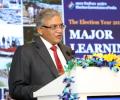
Opposition MPs in India have moved notices in Parliament seeking the removal of Chief Election Commissioner Gyanesh Kumar, accusing him of bias, misconduct, and acting under the influence of the executive.

RSS chief Mohan Bhagwat cast his vote in the Nagpur Municipal Corporation (NMC) polls and commented on the NOTA option, stating it indirectly helps promote an unwanted candidate.

...reopen for up to six months. Until then, the Strait stays nearly closed. The world pays. And no one, including the man who started this, can say when it ends, notes Prem Panicker in his must read blog on the Iran War.
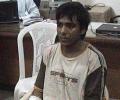
'The jail staff told me Kasab was served only jail food and not biryani.' 'They told me that Kasab was beaten regularly after court proceedings.' 'And they filled Kasab's bottle with urine so that whenever he felt thirsty he used to drink urine.'

Modi urged the youngsters to celebrate when they or a person around them becomes a voter for the first time.
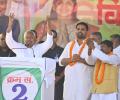
'If the RJD loses it would be out of power for nearly 25 years. Meanwhile, the JD-U will have survival issues if it gets less number of seats.'
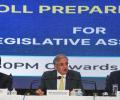
The Chief Election Commissioner, Gyanesh Kumar, has stated that the primary goal of the Election Commission is to ensure all voters in West Bengal can participate in the upcoming assembly elections without violence or intimidation.

Like the realisation on the failure of development, we have also internalised the failure on democracy, argues Aakar Patel.
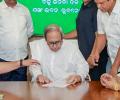
BJD chief Naveen Patnaik has called for Odisha Chief Minister Mohan Charan Majhi's intervention to restore law and order after an attack on the residence of senior BJD leader Pratap Jena. The incident has sparked a political row, with allegations of internal conflict within the BJD.
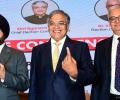
'The current Election Commission functions more like a government department than an autonomous body.'

The Lok Sabha has revoked the suspension of eight opposition MPs after assurances of maintaining order and decorum in the House. The decision follows a period of disruption and debate over parliamentary conduct.

'Some states have become more populous, while others have become less populous. Those who became less populous became economically strong. Those where population increased, they became economically weak

Aiyar's endorsement of Kerala Chief Minister Pinarayi Vijayan has ignited a political firestorm, drawing sharp rebukes from his own party.

The Congress party extended best wishes to the newly-elected Vice President of India, C P Radhakrishnan, while also recalling the words of the first Vice President, Sarvepalli Radhakrishnan, on the importance of a strong opposition in a democracy.

'Nitish Kumar may be marginalised as an office-holder, but that is not the same thing as the disappearance of Nitish Kumar's politics.'

Tarique Rahman is Bangladesh's first male prime minister in more than three decades, ending an era of female leadership that began in 1991.

Union Minister Shivraj Singh Chouhan criticised the West Bengal government over law and order and accused the TMC of sheltering infiltrators and manipulating demographics.

The ceasefire is still technically holding, to the extent that no overt hostilities have been reported yet, but the rhetoric has hardened dangerously. The week ahead will also clarify whether the Islamabad failure was a negotiating tactic or whether Washington has genuinely locked itself into a position from which the only exits are climb-down, escalation, or the slow bleed of a new status quo that nobody chose and nobody controls. Prem Panicker continues his must read blog on the Iran War.

Lok Sabha Speaker Om Birla and Foreign Secretary Vikram Misri attended the swearing-in ceremony.

The voting for the 13th parliamentary elections was held along with a referendum on a complex 84-point reform package.

Former Maldives President Mohamed Nasheed advocates for building democratic institutions over military intervention in resolving international conflicts, particularly in the context of the escalating West Asia crisis. He also discusses the impact of the conflict on the Maldives' tourism-dependent economy and calls for a stronger, more understanding India in the Indian Ocean Region.

Tarique Rahman, after 17 years in self-exile, has led the Bangladesh Nationalist Party (BNP) to a significant victory, becoming the country's Prime Minister. This marks a major turnaround for the BNP after years of being targeted by the Awami League government.
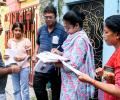
The upcoming publication of West Bengal's electoral rolls is expected to intensify political tensions and debates ahead of the Assembly elections, reflecting concerns about voter inclusion and identity.
Maharashtra Governor C P Radhakrishnan reflects on his tenure as he prepares to move to Delhi as the next Vice President of India, calling it the happiest period in his public life.

A public exchange of open letters between Congress leaders Mani Shankar Aiyar and Shashi Tharoor reveals a significant rift over foreign policy, particularly concerning Israel and the Sabarimala temple issue.

BNP chairman Tarique Rahman called for maintaining law and order and sought cooperation in building a safe and humane Bangladesh after his party's victory in parliamentary elections.

West Bengal Chief Minister Mamata Banerjee escalates tensions ahead of assembly polls by accusing President Droupadi Murmu of political bias and criticising her stance on tribal welfare, sparking a major controversy.

Film stars arrived at polling booths in Mumbai to cast their votes in the ongoing Brihanmumbai Municipal Corporation (BMC) elections. The elections are seen as crucial for major cities such as Mumbai, Pune, Nagpur, Thane, Navi Mumbai, Nashik, and Pimpri-Chinchwad.
Following the BNP's victory in recent elections, Bangladesh is seeking to reset its relationship with India, emphasizing mutual benefit and a recognition of the changed political landscape.
A political controversy has erupted in West Bengal after President Droupadi Murmu raised concerns about the lack of development among tribal communities, leading to a clash between Chief Minister Mamata Banerjee and Prime Minister Narendra Modi.

Sensitive issues remain. Water sharing of the Ganga and Teesta rivers. Treatment of minorities, particularly Hindus. Border management. Trade imbalances. Connectivity projects.What happens next will shape not just bilateral ties, but the balance of South Asia itself, points out Ramesh Menon.
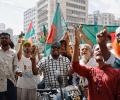
Bangladesh is preparing for elections and a referendum on reforms, but the absence of the Awami League and rising political tensions are raising concerns about the legitimacy and stability of the process.

Over 90 former bureaucrats have expressed concern over the Special Intensive Revision (SIR) of electoral rolls in Bihar, alleging it could disenfranchise voters, particularly the poor and marginalized.

The Shiv Sena has moved its newly elected corporators to a luxury hotel as the race to pick the next Mumbai mayor intensifies. The move comes amid political maneuvering and strategic positioning following recent civic poll results.

'If this region destabilises, then we are not far away. This region should not destabilise.'

Amid escalating tensions, Iranian Deputy Foreign Minister Saeed Khatibzadeh declares Iran's unwavering commitment to a 'heroic nationalist defence' against perceived American and Israeli aggression, vowing to resist what he calls an 'invasion' to the very end.
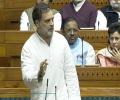
Congress leader Rahul Gandhi accuses the BJP of 'vote chori' in collusion with the Election Commission, calling it an anti-national act. He raised concerns about election reforms and institutional capture.
